


Secondly, record summer demand is met
The demand side is also "firing at full power." In July, Guangdong's total social power consumption reached 100.798 billion kilowatt-hours, making it the first province in the nation to exceed 100 billion kilowatt-hours in a single month. On July 31, Jiangsu's power grid reached a peak load of 160.9 million kilowatts, becoming the first provincial power grid within the State Grid system to exceed 160 million kilowatts. The six major coastal power consumption days remained above 940,000 tons, and the pressure on power plant storage remains, with the tight supply-demand structure providing strong support for electricity prices.
Thirdly, power marketization reform deepens
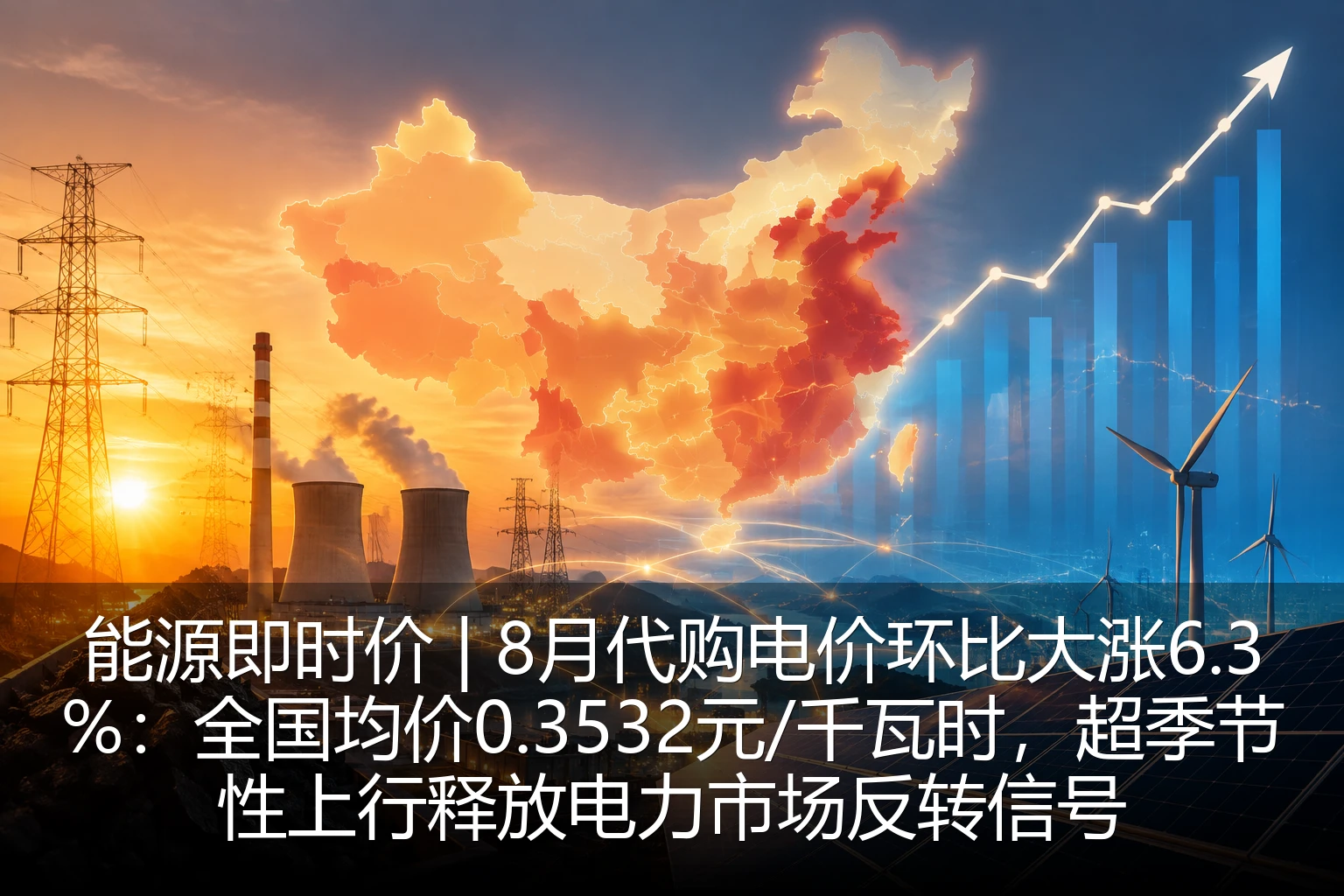
Since the comprehensive rollout of the marketization reform for coal-fired power generation electricity prices in 2021, "agent power purchasing" has become a vital channel for industrial and commercial users to enter the power market. Users who have not directly purchased power from the market are served by power grid enterprises through unified agent purchasing, with prices announced monthly. The agent purchasing price comprehensively reflects the grid power price, ancillary service fees, and market transaction results, serving as a key window for observing the center of the power market price. As medium-to-long-term transactions, spot markets, and capacity pricing mechanisms continuously mature, the transmission of coal price signals to terminal electricity prices has become increasingly sensitive, and the expansion of this round of price increases is a manifestation of the effectiveness of the market-based pricing mechanism.
Industry Interpretation: Electricity Price Bottom Reversal, Deeper Dividend Logic
For the power industry, electricity price is a "lifeline." Over the past two years, under the dual squeeze of falling electricity prices and rising coal prices, the thermal power sector's performance has been under pressure, and the fund holdings of the public utility sector have dropped to 0.26%, the lowest since 2021, placing it in a historically low allocation state. This super-seasonal rise in agent purchasing prices is viewed by institutions as a critical node—a "clear signal of the electricity price bottom"—if the electricity price bottom is confirmed in 2026, electricity revenue in 2027 is expected to experience deflation, and assets such as thermal and hydropower are expected to achieve a "double boost" in performance and valuation, while the coal sector can also maintain outperformance through both volume and profit increases.
At the same time, the pace of green power installed capacity and consumption, and power system reform policies, remains an important variable influencing the long-term center of electricity prices. For investors, the electricity price inflection point signifies a deepening of the dividend asset allocation logic: not only do traditional high-dividend thermal and hydropower benefit, but green power operators with cost advantages and consumption guarantees will also gain clearer profit expectations.
Asia-Pacific Perspective: Electricity Price Signals Reshaping Regional Energy Landscape
Looking at the Asia-Pacific, changes in China's electricity price curve are not isolated events. In July, Laos's inflation rate rose to 7.6%, with a significant rise in electricity prices being the main driver, and energy costs are taking over from exchange rates as a new engine of regional inflation; Southeast Asian countries such as Vietnam and Indonesia are also facing pressure from tight power supply and demand and rising electricity prices. As a "Southeast Asian battery," Laos exports electricity to neighboring countries based on rich hydropower resources. The deepening of China's power marketization reform and the upward shift of the electricity price center are expected to help raise the pricing benchmark for cross-border green power trading in the medium to long term, and open up broader space for China-Laos power interconnection and ASEAN grid integration.
For investors monitoring the Asia-Pacific energy market, electricity price is not just a cost, but a cyclical signal. From coal price transmission and demand peaks to market mechanisms, every variable is reshaping the value coordinates of regional power assets. The trend of energy spot prices often precedes the valuation inflection point of assets and is worth continuous tracking.
(This article is compiled based on public market data and institutional research and does not constitute investment advice.)