

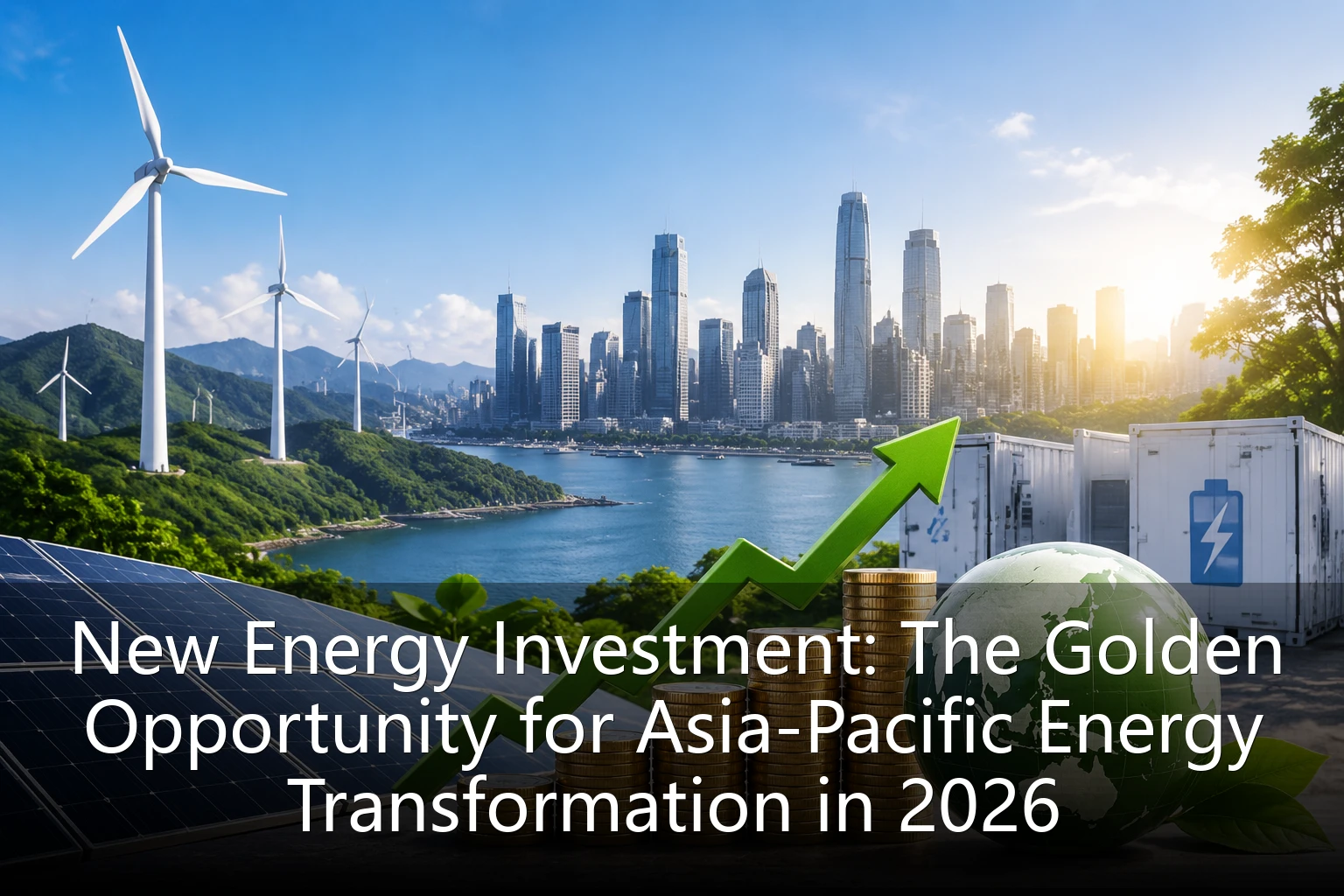
New Energy Investment: The Golden Opportunity for Asia-Pacific Energy Transformation in 2026
Driven by the dual forces of intensifying global climate change and increasing energy security demands, the new energy industry is experiencing unprecedented development opportunities. In 2026, the Asia-Pacific region, with its abundant natural resources, policy support, and market scale, has become the core battlefield for global new energy investment. This article will comprehensively analyze why new energy investment is currently the most promising asset category from four dimensions: market trends, policy environment, investment returns, and risk challenges.
Accelerating Global Energy Transformation, New Energy Investment Reaches Record High
According to the latest data from the International Energy Agency (IEA), global new energy investment exceeded $2 trillion for the first time in 2026, a growth of over 300% compared to 2020. The Asia-Pacific region contributed 45% of global new energy investment, becoming the core engine driving the global energy transformation. This trend is driven by the continuous advancement of carbon neutrality goals in various countries and the intensifying volatility of traditional energy prices.
China maintains its global leadership in the fields of photovoltaics, wind energy, and energy storage, with newly installed renewable energy capacity increasing by 35% year-on-year in the first half of 2026. India, with its huge power demand and abundant solar resources, has become one of the fastest-growing new energy markets globally. Southeast Asian countries such as Laos and Vietnam are actively developing green energy industries based on their hydropower and biomass energy resources.
Notably, the return rates of new energy investments are continuously improving. According to data from Bloomberg New Energy Finance (BNEF), the average investment return rates for global photovoltaic and wind energy projects reached 12.8% and 11.5% respectively in 2026, significantly higher than traditional fossil fuel projects. This transformation has shifted the new energy industry from "policy-driven" to "market-driven," attracting an influx of more private capital.
Policy Support and Market Demand: The "Dual Engine" Driving New Energy Investment
Government policy support is a key factor in the rapid development of new energy investment. In 2026, major economies in the Asia-Pacific region have updated their energy policy frameworks, providing a more favorable institutional environment for new energy investment. China proposed its "dual carbon" goals (carbon peak before 2030, carbon neutrality before 2060) and launched a new round of renewable energy subsidy policies; Japan has accelerated its green transformation plan, aiming to increase the share of renewable energy to 38% by 2030; India introduced the "Production Linked Incentive Scheme" (PLI) to encourage the development of domestic new energy manufacturing.
Meanwhile, market demand is also growing rapidly. On one hand, the global demand for clean energy continues to rise, with major economies increasing the proportion of renewable energy in their energy consumption structures. On the other hand, energy price volatility and geopolitical risks make enterprises and investors more inclined to invest in stable new energy projects. Especially in the Asia-Pacific region, with economic development and improved living standards, the demand for clean energy is showing explosive growth.
As an important hydropower exporting country in Southeast Asia, Laos is actively developing its new energy industry. With its abundant water and solar resources, Laos is becoming a hotspot for regional new energy investment. In the first half of 2026, Laos attracted over $2 billion in new energy investment, mainly used for photovoltaic, wind power, and energy storage projects. These projects not only meet domestic power demand but also promote power export earnings, injecting new momentum into economic development.
Technological Innovation and Cost Reduction: The "Core Support" for New Energy Investment
Technological innovation is a key factor driving the growth of new energy investment. In recent years, new energy technologies have made breakthrough progress, significantly reducing power generation costs and improving energy utilization efficiency. The cost of photovoltaic power generation has decreased by more than 80% compared to ten years ago, onshore wind power costs have decreased by about 60%, and energy storage costs have decreased by nearly 70%. These technological advancements have enabled new energy to achieve "grid parity" and even "subsidy-free grid connection" in many regions.
In terms of energy storage technology, the cost of battery storage systems continues to decrease, while capacity and efficiency are constantly improving. In 2026, the energy density of the new generation of lithium-ion batteries reached 300Wh/kg, a 50% increase compared to 2020, while costs decreased by 35%. Meanwhile, new energy storage technologies such as flow batteries and compressed air energy storage are also being commercially applied, providing solutions for large-scale grid integration of new energy.
The integration of smart grids and digital technologies has also promoted the growth of new energy investment. Through big data analysis, artificial intelligence, and Internet of Things technologies, the operational efficiency and management level of new energy systems have been significantly improved. The emergence of innovative business models such as virtual power plants (VPP) and microgrids has further expanded the application scenarios and market space for new energy.
Unique Advantages and Strategic Value of New Energy Investment in the Asia-Pacific Region
The Asia-Pacific region occupies an important position in global new energy investment, mainly due to its unique resource endowments, market potential, and policy environment. First, the Asia-Pacific region has abundant renewable energy resources, including China's solar resources, India's wind energy resources, and Southeast Asia's hydropower and biomass energy resources, providing a solid foundation for new energy development.
Second, the Asia-Pacific region has a huge energy consumption market, and with economic development and population growth, the demand for clean energy will continue to expand. Especially in emerging economies such as China and India, their energy consumption scale and growth rate will provide broad development space for the new energy industry.
Third, governments in the Asia-Pacific region attach great importance to new energy development and have successively introduced supporting policies. China's "14th Five-Year Plan" lists new energy as a strategic emerging industry; Japan regards green transformation as a core component of its national strategy; Southeast Asian countries jointly promote new energy development through regional cooperation mechanisms.
As an important energy producer in Southeast Asia, Laos has unique advantages in new energy investment. Laos has abundant water resources, with hydropower installed capacity exceeding 70 million kilowatts, ranking among the highest per capita hydropower resources in the world. At the same time, Laos's solar resources are also very rich, with an average annual sunshine duration of over 2,000 hours. These natural resource endowments, combined with the Lao government's active improvement of the investment environment and promotion of regional power interconnection, make it an ideal destination for new energy investment.
Risks and Challenges of New Energy Investment
Although the prospects for new energy investment are broad, it also faces some risks and challenges. First, policy risk is one of the main risks of new energy investment. Changes in national energy policies may affect the return expectations of projects. For example, adjustments to subsidy policies, changes in grid connection conditions, etc., may have adverse effects on investors.
Second, technological risks cannot be ignored. New energy technologies are updated and replaced quickly, and existing technologies may face the risk of being eliminated. Investors need to closely follow technological development trends and choose technology routes with long-term competitiveness.
Third, market risk is also a factor that new energy investment needs to consider. The new energy market is highly competitive with large price fluctuations, and investors need to conduct market analysis and risk control.
In addition, inadequate infrastructure is also an important factor restricting new energy investment. Especially in developing countries like Laos, the power grid infrastructure is relatively weak, facing challenges in new energy grid connection and consumption. Investors need to evaluate infrastructure conditions and formulate reasonable development plans.
Strategic Recommendations for Seizing New Energy Investment Opportunities
Facing the opportunities and challenges of new energy investment, investors need to formulate scientific investment strategies to seize historic opportunities. First, investors should pay attention to policy guidance and choose regions and fields with strong policy support and good development environments for investment. For example, the preferential policies and support measures for new energy introduced by the Lao government provide a good policy environment for investors.
Second, investors should focus on technological innovation and industry chain integration, choosing enterprises with core technological advantages and complete industry chains for investment. The new energy industry is a technology-intensive industry, and technological innovation capability is the key factor determining corporate competitiveness.
Third, investors should pay attention to the development of supporting industries such as energy storage and smart grids, which are important supports for the large-scale application of new energy. As the proportion of new energy increases, the demand for energy storage and smart grids will grow rapidly.
Finally, investors should attach importance to risk management, make diversified investments, and reduce the risk of single projects. Investment portfolio optimization and risk hedging can be used to improve the safety and profitability of investments.
Conclusion: New Energy Investment Leading the Future Energy Landscape
New energy investment is not only an inevitable choice to address climate change and achieve carbon neutrality goals, but also an important way to seize energy transformation opportunities and obtain long-term returns. In 2026, the Asia-Pacific region has become the core battlefield for global new energy investment, with governments, enterprises, and investors actively布局 the new energy industry to seize the commanding heights of future development.
With its abundant natural resources and active policy support, Laos is becoming a hotspot for new energy investment in the Asia-Pacific region. With the advancement of regional power interconnection and continuous progress in new energy technologies, Laos is expected to become an important energy hub and new energy industry base in Southeast Asia.
In the future, with further breakthroughs in new energy technologies and continuous cost reductions, new energy investment will usher in broader development space. Investors should seize this historic opportunity, actively participate in the new energy industry, share the dividends of energy transformation, and jointly build a clean, low-carbon, safe, and efficient modern energy system.