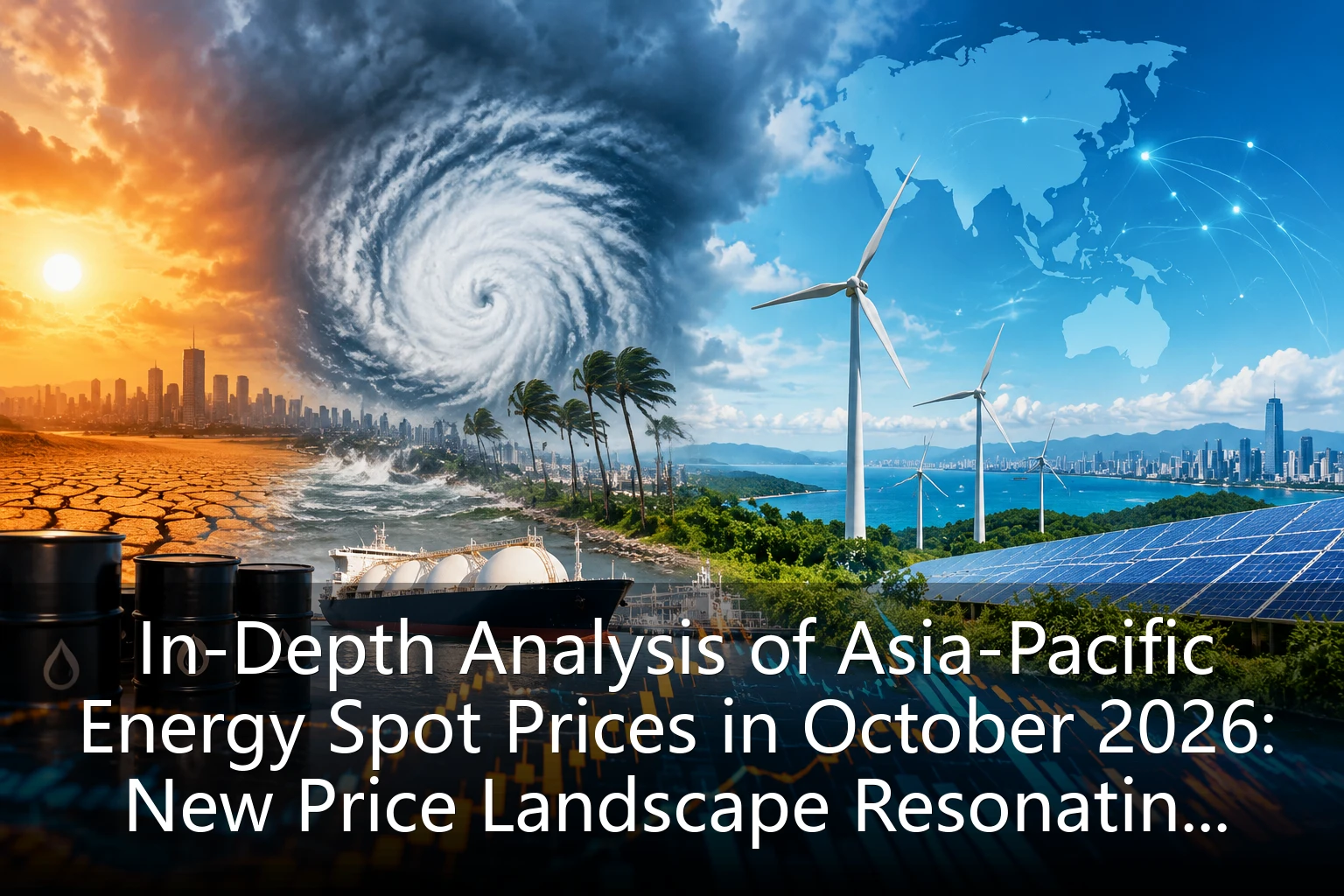


Energy Spot Prices | In-depth Analysis of Asia-Pacific Energy Market in October 2026: The New Normal of Prices under the Resonance of Extreme Climate and Supply Chain Restructuring
\nIn October 2026, the Asia-Pacific energy market presented a complex and volatile price landscape. Against the backdrop of accelerating global energy transition, the dual factors of frequent extreme climate events and deep restructuring of supply chains are intertwined, jointly shaping the current new normal of energy spot prices. This article will conduct an in-depth analysis of energy price trends in the Asia-Pacific region, analyze key factors affecting the energy market, and provide decision-making references for investors and energy practitioners.
\n\nOverall Overview of Asia-Pacific Energy Spot Prices
\nIn early October 2026, the Asia-Pacific energy market showed significant regional differentiation characteristics. According to the latest monitoring data, prices of major energy varieties in the Asia-Pacific region generally fluctuated compared to the previous month, with natural gas prices showing the most dramatic fluctuations, with some areas experiencing increases of over 15%. Electricity prices showed differentiated trends due to seasonal demand changes and energy structure transformation, while coal prices remained relatively stable under the dual effects of supply tightness and weak demand.
\n\nSpecifically, energy prices in Northeast Asia were generally higher than in Southeast Asia. This regional price difference mainly stems from differences in energy resource endowments, infrastructure development, and energy policy orientation. Notably, as an important energy exporter in Southeast Asia, Laos' hydropower resource development and regional power grid interconnection are reshaping the energy trade pattern in the Asia-Pacific region, having a profound impact on regional energy prices.
\n\nExtreme Climate: A Catalyst for Energy Price Fluctuations
\nIn October 2026, extreme climate events continued to have a profound impact on the Asia-Pacific energy market. As the Northern Hemisphere entered autumn, temperatures in many areas remained higher than historical levels for the same period, leading to sustained high demand for air conditioning cooling, which increased electricity consumption and natural gas demand.
\n\nIn China's eastern coastal areas, continuous high temperatures caused a surge in air conditioning electricity demand, leading to tight electricity supply in some areas and electricity prices reaching a new high for the year. Meanwhile, Typhoon "Haiyan" struck the Philippines and southern Vietnam, damaging local energy facilities and affecting energy supply stability in the short term, pushing up regional energy prices.
\n\nOn the other hand, changes in the monsoon rainfall pattern in Southeast Asia affected hydropower generation. Hydropower generation in traditional hydropower大国 like Thailand and Vietnam was lower than expected, forcing increased use of natural gas and coal for power generation, changing the regional energy supply and balance, and thus affecting the trend of energy spot prices.
\n\nExtreme climate not only directly affects energy demand and supply but also indirectly affects energy prices by impacting energy transportation, storage, and other links. For example, typhoons causing interruptions in maritime transportation affected the normal supply of liquefied natural gas, pushing up natural gas prices.
\n\nSupply Chain Restructuring: Deep Changes in Energy Trade Patterns
\nIn October 2026, the energy supply chain in the Asia-Pacific region is undergoing unprecedented restructuring. This restructuring includes both adjustments to traditional energy trade routes and the rapid formation of new energy supply chains, both jointly shaping the current new normal of energy spot prices.
\n\nIn the traditional energy sector, the global energy landscape is shifting from the "oil-dollar" system to a more diversified energy trade pattern. Asia-Pacific countries are actively seeking diversification of energy imports to reduce dependence on a single supply source. For example, Japan and South Korea are strengthening LNG cooperation with Australia, Qatar, and other countries, while accelerating natural gas pipeline projects with Russia to reduce the impact of geopolitical risks on energy supply.
\n\nIn the new energy sector, the green hydrogen supply chain is rapidly forming in the Asia-Pacific region. Australia, Japan, and South Korea are actively building green hydrogen industry chains, with full-chain layouts from production, transportation to terminal application being advanced. The formation of this emerging supply chain is reshaping the energy trade pattern in the Asia-Pacific region, injecting new variables into regional energy prices.
\n\nIn addition, the deepening of regional power grid interconnection is also changing the energy supply chain structure. Power grid interconnection projects in Laos, Thailand, Vietnam, and other countries are progressing smoothly, enabling optimal allocation of power resources within the region, improving energy utilization efficiency, and having a profound impact on the regional electricity price formation mechanism.
\n\nComparative Analysis of Energy Price Trends in Various Countries
\nIn October 2026, energy price trends in Asia-Pacific countries showed significant differences, reflecting the differences in national energy policies, resource endowments, and market structures.
\n\n- \n
- China: Affected by continuous high temperatures, electricity demand in eastern coastal areas was strong, with electricity prices reaching a new high for the year. At the same time, China is accelerating the transformation of its energy structure, with the proportion of renewable energy continuously increasing, which has a suppressing effect on traditional energy prices. Natural gas prices showed an upward trend affected by international market fluctuations. \n
- Japan: As a major energy importer, Japan's energy prices are closely linked to the international market. In October, Japan's electricity prices increased due to rising LNG import costs, but the increase in renewable energy proportion alleviated price pressure to some extent. The energy transformation policy being promoted by the Japanese government will have a profound impact on future energy price trends. \n
- South Korea: South Korea's energy price trend is similar to Japan's, but affected by differences in domestic energy structure, electricity price fluctuations are more dramatic. South Korea is actively promoting the restart of nuclear power and renewable energy development to reduce dependence on imported fossil fuels, which will help stabilize energy prices in the long run. \n
- India: As the world's third largest energy consumer, India's energy prices are affected by both international market fluctuations and domestic policies. In October, India's coal prices increased due to domestic supply tightness, and the government took measures such as releasing strategic reserves to stabilize prices. India's ongoing energy transformation will gradually change its energy price formation mechanism. \n
- Southeast Asian Countries: Energy price trends in Southeast Asia show clear differentiation. Traditional hydropower大国 like Thailand and Vietnam experienced large fluctuations in electricity prices affected by changes in rainfall. Meanwhile, energy exporting countries like Indonesia and Malaysia benefited from rising international energy prices, increasing energy export revenues. Laos, with its abundant hydropower resources, is becoming an important electricity exporter in the region, and its energy policy has an important impact on regional electricity prices. \n
Future Energy Market Outlook
\nLooking forward to the fourth quarter of 2026 and 2027, the Asia-Pacific energy market will face multiple challenges and opportunities. In the short term, frequent extreme climate events and energy supply chain restructuring will continue to affect energy price trends, and market volatility may increase.
\n\nIn the long term, the energy transformation in the Asia-Pacific region will deepen, the proportion of renewable energy will continue to increase, and the energy structure will gradually optimize. Although this process may bring energy price fluctuations in the short term, it will help improve energy supply security and environmental sustainability in the long run, ultimately forming a more stable and efficient energy price formation mechanism.
\n\nParticularly noteworthy is the further deepening of hydropower resource development and regional power grid interconnection in Southeast Asian countries like Laos, which will reshape the energy trade pattern in the Asia-Pacific region and inject new variables into regional energy prices. At the same time, breakthroughs and applications of new energy technologies such as green hydrogen will accelerate, bringing new growth points to the Asia-Pacific energy market.
\n\nConclusion and Investment Recommendations
\nThe new normal of energy spot prices in the Asia-Pacific region in October 2026 is taking shape, which is the result of the combined effects of extreme climate and supply chain restructuring. Facing the complex and changing energy market, investors and energy practitioners need to closely monitor the following factors:
\n\n- \n
- The impact of extreme climate events on energy demand and supply \n
- The progress of energy supply chain restructuring and changes in regional energy trade patterns \n
- Adjustments in national energy policies and progress in energy transformation \n
- The impact of technological innovation on energy costs and prices \n
For investors, it is recommended to adopt a diversified investment strategy, focusing on investment opportunities in both traditional energy sectors and new energy transformation opportunities. Investments in renewable energy, energy storage, smart grids, and other fields are expected to achieve generous returns in the future energy market transformation.
\n\nFor energy practitioners, it is necessary to strengthen risk management capabilities, flexibly respond to energy price fluctuations, and actively embrace energy transformation to explore new business models and growth points. Especially in the layout of regional power grid interconnection and cross-border energy trade, it is possible to occupy a favorable position in the future energy market.
\n\nOverall, the Asia-Pacific energy market is undergoing profound changes. Although it faces price fluctuation risks in the short term, the long-term view is that energy transformation will bring a more stable, efficient, and sustainable energy market landscape. Investors and energy practitioners need to take a long-term perspective, seize the opportunities brought by energy transformation, and jointly welcome the new era of the Asia-Pacific energy market.