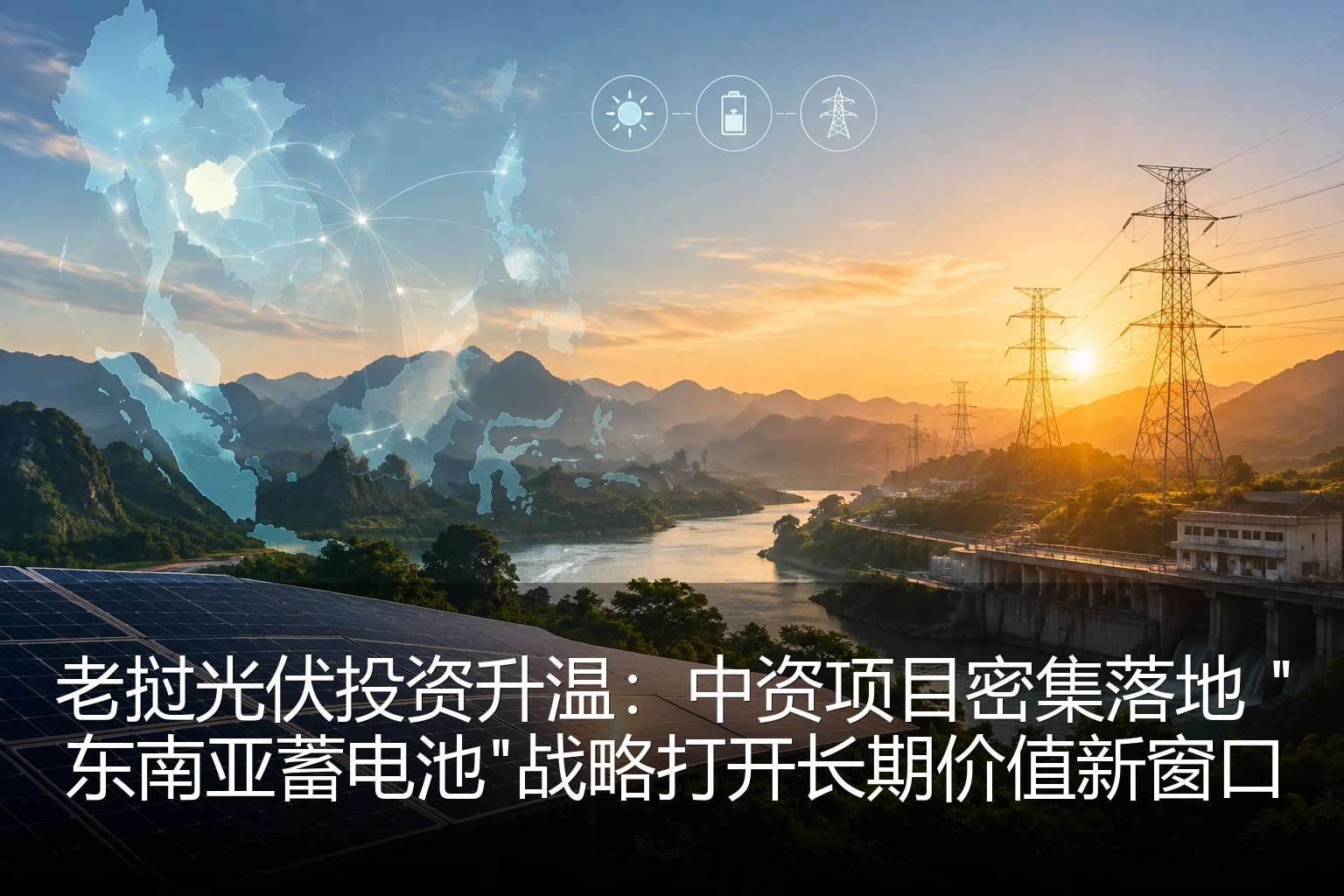
As August begins, the Lao photovoltaic market is experiencing a new round of intensive activity. On July 31st, Zhao Yongli, Chairman of China Datang Overseas Investment Co., Ltd., led a team to inspect the Namam Photovoltaic project site in Oudomxay Province, Laos. During the on-site supervision, he oversaw the preliminary breakthrough work of the project, setting a target to commence construction by September 30th. At almost the same time, the Chongqing Design Institute of China Coal Technology announced the successful penetration of the Southeast Asian photovoltaic market. The 100MW photovoltaic project undertaken in Bokeo Province, Laos, is considered a core component of Laos's national energy reserve system as the "Southeast Asian Battery." Coupled with the 1MW photovoltaic project in Phase I of the North Clean Energy Base in Laos, which was completed and put into operation in April this year, the Lao photovoltaic sector is accelerating from "planning drawings" toward "concentrated realization."
For investors monitoring energy investments in the Asia-Pacific, the signal released by this intensive advancement of Chinese photovoltaic projects in Laos is far more significant than any single project. It signifies that Laos's "Southeast Asian Battery" strategy is shifting from being driven solely by hydropower to a composite growth narrative integrating "hydro, solar, wind, and storage," with cross-border grid connectivity providing a tangible monetization channel for this narrative.
Namam Photovoltaic Targets End-of-September Commencement: A New Benchmark for Sino-Lao Green Cooperation
The Namam Photovoltaic project, located in Oudomxay Province, Laos, is a key undertaking in implementing the "Belt and Road" green development initiative and contributing to building a modern, all-weather community of shared destiny between China and Laos. During the on-site supervision, Zhao Yongli systematically reviewed core aspects such as land approval, feasibility studies, environmental assessments, and grid connection plans, emphasizing that the project team must adhere to timelines and fulfill job responsibilities to complete the CA agreement in high quality and efficiency, fully positioning the project as a model for green energy cooperation between China and Laos.
Notably, during the survey, Zhao Yongli also visited the Namam 3 substation, which is part of the Sino-Lao 500kV interconnection project, and held a precise meeting with Huang Yu, Deputy General Manager of Electricity Distribution Company of Laos (EDL-T), regarding the grid connection and consumption of the Namam photovoltaic power. This means the Namam photovoltaic is not an isolated power station investment but is embedded in a systemic layout of the Sino-Lao cross-border power interconnection corridor—achieving power export through the 500kV interconnection project, which provides infrastructural support for the project's consumption prospects and revenue certainty.
From Hydropower to Photovoltaics: The Expansion of the "Southeast Asian Battery" Landscape
For a long time, Laos's energy landscape has been dominated by hydropower. With the rich water resources of the Mekong River and its tributaries, hydropower exports have long been one of Laos's most important foreign currency sources, leading to the moniker "Southeast Asian Battery." However, hydropower is highly dependent on water flow seasons, with generation capacity significantly declining during the dry season, which provides a natural complementary space for new energy sources like photovoltaics.
The 1MW photovoltaic project in Phase I of the North Clean Energy Base in Laos is a product of this logic. This large-scale mountain photovoltaic project, covering approximately 2100 hectares, is the largest single project in Southeast Asia and the first large-scale mountain photovoltaic project in Laos, having been completed and put into operation in April this year. Mr. Malethong Kommasi, Minister of Industry and Commerce of Laos, commented that the project has not only promoted the realization of power interconnection between Laos and China but has also created numerous jobs and driven the development of related industries in Laos. The 100MW project undertaken by China Coal Technology in Bokeo Province, which plans for 12 large photovoltaic arrays and is equipped with a multi-voltage hub substation at 22kV/35kV/115kV/230kV, can stably transmit over 190 million kWh of clean green electricity annually, equivalent to saving about 50,000 tons of standard coal and reducing carbon emissions by nearly 150,000 tons each year. From the scale and pace of projects, Lao PV is showing a clear model of "large-scale ground stations + cross-border export," highly similar to the hydropower development path of the past—attracting foreign investment through resource endowment, then achieving large-scale export relying on the international grid, ultimately forming a complete cycle of "development—transmission—monetization."
Why Invest in Energy: The Triple Support of Policy, Grid, and Demand
To answer the question of "why invest in energy," Lao PV provides answers across three dimensions:
Policy Dimension: At the regular meeting of the Lao government in July, officials reaffirmed plans to promote electric vehicles and renewable energy to reduce reliance on fuel imports; simultaneously, the controlled operations matters stipulated in the Law on Investment Promotion were reduced from 44 to 20, sending a clear signal to simplify investment processes and attract foreign capital. As a landlocked country highly dependent on imported fuels, developing domestic renewable energy in the context of global fuel market volatility has become a necessity for Lao.
Grid Dimension: The construction and operation of cross-border channels, such as the China-Laos 500kV interconnected grid project, has solved the major pain point of new energy being "generated but unable to be transmitted." The Asian Development Bank's "Pan-Asian Grid Initiative" further aims to achieve approximately 20 GW of cross-border renewable energy integration by 2035, with 22,000 km of transmission lines and improving energy access for 200 million people. Regional grid interconnection provides a vast absorption base for Lao new energy.
Demand Dimension: Industrialization and data center construction are accelerating in Southeast Asia, leading to continuously rising power demand. Countries such as Thailand and Vietnam have recently tightened data center investment standards and promoted green power procurement. The demand for green power trading in the region is robust, creating a considerable buyer's market for Lao PV exports.
Investment Perspective: Coexistence of Growth and Certainty
From the perspective of investment returns, Lao PV projects possess both "growth potential" and "certainty": on one hand, the excellent solar resource endowment, competitive land and labor costs, and regional cost advantages in electricity generation make it attractive; on the other hand, relying on cross-border grid export and long-term power purchase agreements, the project's cash flow stability is superior to that of most emerging markets, aligning with the preferences of energy investors seeking long-term, stable returns.
The actions of global energy giants also confirm the capital attractiveness of new energy assets. In early August, TotalEnergies announced the acquisition of Shell's onshore renewable energy business in Europe, involving 500 MW of operational and in-development assets and a 3.5 GW project reserve, while selling a 50% stake in some developed asset portfolios to KKR to recover capital. This combination of "M&A expansion + asset monetization" is a typical strategy of mature capital during the energy transition—it firmly believes in the long-term value of new energy while improving capital efficiency and balancing the balance sheet through structural optimization.
Of course, investors must also be aware of risks. Lao PV projects still face uncertainties in the preliminary stages, such as land approval, environmental assessment, and grid connection timing. Construction difficulty during the rainy season may extend the project execution cycle. The electricity pricing mechanism and cross-border power trading rules in the region are still being refined, and electricity price fluctuations may affect revenue expectations. Furthermore, geopolitical and regional exchange rate fluctuations require investors to dedicate more effort to project due diligence and financing structure design.
Conclusion: The "Lao Variable" in the Southeast Asian Energy Landscape From hydropower export revenue to the dense deployment of photovoltaics, from domestic consumption to cross-border power transmission, Laos is undergoing a silent upgrade of its energy system. For investors, Laos's solar potential offers not just specific project investment opportunities, but also a window into the pace of energy transition in Southeast Asia. As the "Southeast Asian battery" begins to inject both water and solar energy simultaneously, the long-term value logic of energy investment is becoming clearer along the Mekong River.