

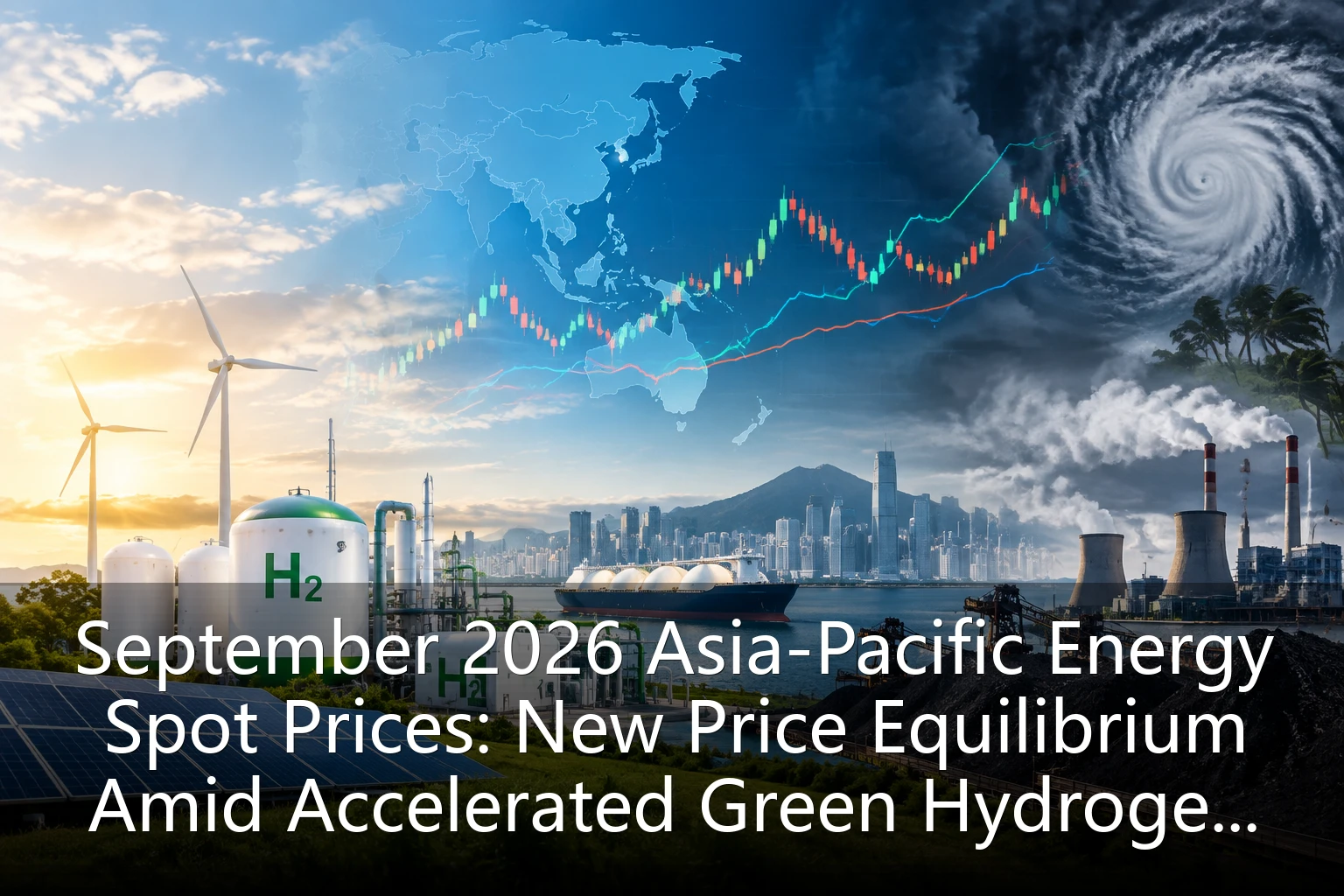
In September 2026, the Asia-Pacific energy market is undergoing a price transformation driven by extreme climate and accelerated green hydrogen capacity release. Persistent high temperatures, frequent typhoons, and the rapid expansion of the green hydrogen industry have led to a clear divergence in price trends between traditional energy (e.g., natural gas, coal) and new energy (e.g., green hydrogen, renewable energy). This divergence not only reflects the deepening of energy transition but also highlights the importance of regional cooperation in addressing energy price volatility. As key participants in the Asia-Pacific energy market, economies such as Laos, China, Japan, and South Korea offer new observation windows for the global energy market through changes in their energy spot prices.
I. Surge in Traditional Energy Demand Under Extreme Climate
In September 2026, the Asia-Pacific region experienced the most severe extreme climate events in recent years. Southern China faced persistent high temperatures exceeding 40°C, leading to a surge in air conditioning electricity demand; Japan and South Korea were hit by typhoons, damaging power facilities and increasing temporary power demand. These extreme weather events directly boosted demand for traditional energy, thereby affecting their spot prices.
According to data from the Asia-Pacific Energy Intelligence (AEI), electricity prices in East China rose by 8.2% in September 2026 compared to the previous month, with industrial electricity prices in cities like Shanghai and Nanjing exceeding 1.2 yuan per kWh, reaching a new high for the year. This increase was mainly due to rising coal prices—high temperatures increased coal demand, and domestic coal mine capacity was limited, causing coal prices to rise by 5.3% from the previous month, which in turn pushed up thermal power costs. Meanwhile, natural gas prices also fluctuated; China's imported liquefied natural gas (LNG) price rose by 4.1% to $650 per ton, mainly because typhoons disrupted operations at coastal LNG receiving terminals, temporarily shrinking supply.
In Japan, electricity prices also showed an upward trend in September. Tokyo Electric Power Company's residential electricity price rose by 6.5% to 28 yen per kWh. This increase was related to power facility damage caused by typhoons, leading to tight power supply in the Tokyo area and forcing the power company to increase natural gas power generation. Japan's imported LNG price rose by 3.8% to $680 per ton, further pushing up electricity prices. South Korea's situation was similar; electricity prices in Seoul rose by 7.1% to 1,450 KRW per kWh, mainly due to increased air conditioning demand from high temperatures and rising coal prices (South Korea's imported coal price rose by 4.7% from the previous month).
The situation in Southeast Asia was different. As a major hydropower exporting country, Laos' electricity prices remained stable or slightly decreased in September. Data from Laos Electricity (EDL) showed that Laos' electricity export prices to Thailand and Vietnam fell by 1.2% to $0.08 per kWh. This was partly because Laos has sufficient hydropower capacity, and partly because power demand in Thailand and Vietnam decreased due to typhoons, reducing demand for Laos' electricity. However, Laos' natural gas prices rose; due to increased domestic natural gas demand (mainly for industrial and residential use), natural gas prices rose by 3.5% to $0.75 per cubic meter.
II. Suppression of Traditional Energy Prices by Accelerated Green Hydrogen Capacity Release
In contrast to the surge in traditional energy demand, the rapid expansion of green hydrogen capacity is suppressing traditional energy prices. In 2026, green hydrogen capacity in the Asia-Pacific region increased by 35% compared to 2025, reaching 1.2 million tons per year. This growth is mainly due to policy support and increased investment from countries such as China, Japan, and South Korea.
China's green hydrogen capacity expansion is particularly notable. In September 2026, China added 80,000 tons of new green hydrogen capacity per month, mainly from renewable energy electrolyzer projects in Inner Mongolia and Xinjiang. The commissioning of these projects reduced China's demand for natural gas, as some industrial users began using green hydrogen as a raw material instead. According to data from China National Petroleum Corporation (CNPC), China's natural gas consumption fell by 2.3% in September compared to the previous month, while green hydrogen consumption increased by 15%. This change led to a 2.1% drop in China's imported LNG price to $635 per ton, despite temporary supply contraction from typhoons, as the substitution effect of green hydrogen offset part of the demand growth.
Japan's situation was similar. In September 2026, Japan added 30,000 tons of new green hydrogen capacity per month, mainly from electrolyzer projects in Fukushima and Hokkaido. These projects, built through government-enterprise cooperation, aim to reduce dependence on imported natural gas. According to data from the Ministry of Economy, Trade and Industry (METI), Japan's natural gas consumption fell by 1.8% in September compared to the previous month, while green hydrogen consumption increased by 12%. This change led to a 1.5% drop in Japan's imported LNG price to $670 per ton. Meanwhile, Japan's electricity prices stabilized due to the addition of green hydrogen; Tokyo Electric Power Company's electricity price increase fell from 6.5% in August to 5.2% in September, mainly because increased green hydrogen power generation eased power supply tensions.
South Korea's green hydrogen capacity is also growing rapidly. In September 2026, South Korea added 20,000 tons of new green hydrogen capacity per month, mainly from projects in Busan and Incheon. These projects, built through cooperation between Korea Electric Power Corporation (KEPCO) and private enterprises, aim to meet industrial users' green hydrogen demand. According to data from the Ministry of Economy (MOE), South Korea's natural gas consumption fell by 1.5% in September compared to the previous month, while green hydrogen consumption increased by 10%. This change led to a 1.2% drop in South Korea's imported LNG price to $640 per ton. Meanwhile, South Korea's electricity price increase fell from 7.1% in August to 6.3% in September, with the substitution effect of green hydrogen playing an important role.
III. Price Differentiation in the Asia-Pacific Energy Market and Industry Insights
In September 2026, price differentiation in the Asia-Pacific energy market is mainly reflected in two aspects: first, the divergence in price trends between traditional energy (natural gas, coal) and new energy (green hydrogen, renewable energy); second, differences in energy prices across regions. This differentiation reflects the deepening of energy transition and the importance of regional cooperation in addressing energy price volatility.
First, the divergence in price trends between traditional and new energy. According to data from the Asia-Pacific Energy Intelligence (AEI), natural gas prices in the Asia-Pacific region rose by 2.1% in September 2026 compared to the previous month, while green hydrogen prices fell by 3.5%. This divergence is mainly due to the rapid expansion of green hydrogen capacity and the surge in traditional energy demand. The increase in green hydrogen capacity led some industrial users to switch to green hydrogen, reducing demand for natural gas and thus suppressing its price. Meanwhile, extreme climate increased traditional energy demand, pushing up its price, but the substitution effect of green hydrogen offset part of the increase, making the price rise of traditional energy lower than expected.
Second, differences in energy prices across regions. Traditional energy prices in countries like China, Japan, and South Korea rose due to extreme climate, while traditional energy prices in Southeast Asian countries like Laos remained stable or slightly decreased. This difference mainly stems from differences in energy structure: China, Japan, and South Korea rely mainly on traditional energy, while Laos relies on renewable energy (hydropower). Laos has sufficient hydropower capacity to meet domestic and export demand, so its electricity prices remain stable; whereas in China, Japan, and South Korea, traditional energy demand increased due to extreme climate, leading to price rises.
Industry experts believe that this price differentiation is an inevitable result of energy transition. Li Ming, chief analyst at the Asia-Pacific Energy Research Center (AERC), stated: "Extreme climate is a short-term factor, while the expansion of green hydrogen capacity is a long-term trend. In the future, as green hydrogen capacity further increases, traditional energy prices will face greater suppression, and the price landscape of the energy market will become more diversified." At the same time, regional cooperation is also an important means to address price volatility. The grid interconnection between Laos, Thailand, and Vietnam allows Laos' hydropower to be transmitted to regions with high demand, easing power supply tensions and stabilizing electricity prices. This regional cooperation model is worth emulating by other Asia-Pacific countries.
IV. Future Outlook: Price Equilibrium in Energy Transition
Looking ahead, the Asia-Pacific energy market will continue to show a trend of price differentiation. Extreme climate events may continue, boosting demand for traditional energy; while the expansion of green hydrogen capacity will accelerate, further suppressing traditional energy prices. This trend will have a significant impact on energy investors, enterprises, and consumers.
For investors, the green hydrogen industry will become a new investment hotspot. According to data from the Asia-Pacific New Energy Investment Association (ANVIA), green hydrogen investment in the Asia-Pacific region grew by 40% in 2026 compared to 2025, reaching $15 billion per year. Investors should focus on segments in the green hydrogen industry chain such as electrolyzers, hydrogen storage, and transportation, which have great growth potential.
For enterprises, it is necessary to adjust the energy structure and increase the proportion of green hydrogen use to reduce energy costs. For example, China's steel enterprises have begun using green hydrogen to replace natural gas as a reducing agent, lowering production costs; Japan's chemical enterprises use green hydrogen to replace natural gas as a raw material, reducing carbon emissions.
For consumers, fluctuations in electricity and natural gas prices will affect living costs. However, as green hydrogen capacity increases, energy prices will gradually stabilize. In the long run, consumers will benefit from cost reductions brought by energy transition.
In summary, the changes in Asia-Pacific energy spot prices in September 2026 reflect the deepening of energy transition and the importance of regional cooperation. In the future, with the further expansion of green hydrogen capacity and strengthened regional cooperation, the Asia-Pacific energy market will become more diversified and stable, providing new experiences for global energy transition.