

Africa's New Energy Transition: Breaking the Energy Deadlock, Driving a Green Industrial Revolution
Introduction
The African continent stands at a historic crossroads. On one hand, this land, home to about 20% of the global population, consumes only about 6% of the world's energy, with nearly 600 million people still living without electricity. On the other hand, as industrialization and urbanization accelerate, Africa's energy demand is climbing at an unprecedented rate. The rapid development of new energy sectors such as solar, energy storage, and green hydrogen offers Africa a chance to leapfrog traditional fossil fuel paths and directly embrace a green future. The African Union's Agenda 2063 clearly lists energy green transition and industrial development as core goals. The Dar es Salaam Energy Declaration, jointly signed by 48 African countries in 2023, further demonstrates the collective determination of African nations to drive economic structural upgrading through new energy. This article delves into the opportunities and challenges of Africa's new energy transition and its profound impact on the global energy landscape and sustainable development.
1. Energy Predicament: A Key Bottleneck Restricting Africa's Development
Africa's chronic power shortage has long plagued all levels of its economy and society. Sub-Saharan Africa's per capita annual electricity consumption is less than 500 kWh, only one-sixth of the world average. Businesses bear high operating costs due to unstable power supply; many factories have to run diesel generators, increasing both production costs and carbon emissions. According to statistics, power shortages cost Africa about 2% to 4% of its GDP each year.
At the same time, Africa's energy structure is heavily dependent on fossil fuels and traditional biomass. Oil, natural gas, and coal dominate power generation capacity, while wood and charcoal remain the primary cooking energy for hundreds of millions of rural households, causing severe deforestation and indoor air pollution. This coexistence of energy poverty and energy dependence hinders the achievement of the UN Sustainable Development Goals and constrains Africa's ability to participate in the global carbon neutrality process.
2. New Energy Revolution: From 'Follower' to 'Leapfrogger'
However, this latecomer disadvantage also provides a unique opportunity for Africa to achieve 'leapfrog' development using the latest technologies. Unlike developed countries that need to overhaul vast existing fossil fuel infrastructure, Africa's large-scale power infrastructure is just beginning, allowing direct deployment of the most advanced clean energy systems.
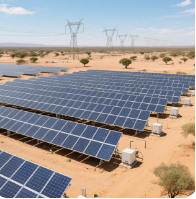
The image above shows an operating large-scale solar photovoltaic power station in Africa. The Sahara Desert and its surrounding areas boast the world's best solar resources, with an average sunshine duration exceeding 3,000 hours per year and a theoretical development potential of over 100 TW. In recent years, South Africa, Morocco, Kenya, and others have built multiple large-scale photovoltaic and solar thermal projects, significantly reducing local electricity costs. Rapid progress in energy storage technology, particularly the more than 80% drop in lithium-ion battery costs over the past decade, has made the solar-plus-storage combination increasingly competitive with fossil fuels.
The green hydrogen sector is the 'crown jewel' of Africa's new energy transition. Africa has the world's richest renewable energy resources, capable of producing low-cost green hydrogen. Countries like Namibia and Mauritania have launched multiple multi-billion-dollar green hydrogen and ammonia projects aimed at exporting clean fuel to Europe and Asia. This not only creates tens of thousands of jobs for Africa but also drives the localization of green manufacturing industries such as electrolyzers and hydrogen storage tanks.
3. Mineral Development and Industrial Upgrading: The Double Dividend of New Energy
The development of the new energy industry forms a positive cycle with the deep exploitation of Africa's critical minerals. Cobalt from the DRC, copper from Zambia, platinum group metals from South Africa, lithium from Zimbabwe—these minerals essential for batteries, motors, and fuel cells are abundant in Africa. In the past, Africa long exported raw ores, stuck at the low end of the global value chain. Now, with the rise of the new energy industry, African countries are actively promoting local mineral processing and battery manufacturing.
The image above clearly shows the distribution of Africa's critical minerals and their key role in the lithium battery industry chain. The African Union's Agenda 2063 sets a target to 'quadruple the value-added of mineral resources' by 2063. The Dar es Salaam Energy Declaration further prioritizes industry chains such as solar energy, energy storage, and electric vehicles. Currently, the DRC is building its first lithium-manganese battery factory, while South Africa is advancing hydrogen fuel cell assembly lines. Once implemented, these projects will significantly enhance Africa's domestic industrial value chain, shifting from simple resource export to technology-intensive manufacturing.
4. Challenges and Pathways: Institutional, Financial, and Grid Upgrades
Despite the bright prospects, Africa's new energy transition faces multiple challenges. First, weak infrastructure. Many countries have low grid coverage, high transmission and distribution losses, and difficulty in connecting new energy projects to the grid. Distributed off-grid systems, while flexible, have limited scale effects and struggle to support large industrial electricity consumption. Second, high financing costs. Africa's sovereign credit ratings are generally low, and international investors demand high risk premiums, resulting in loan interest rates for new energy projects often exceeding 10%, far higher than in developed countries. Additionally, policy instability, talent shortage, and weak local manufacturing capacity also need to be addressed.
To tackle these challenges, the Dar es Salaam Energy Declaration proposes a series of practical measures: promoting cross-border grid interconnection through regional power pools, leveraging international climate funds and green bonds to reduce financing costs, establishing special energy reform funds, and adding new energy professional courses in vocational education systems. Last year's AU Summit also adopted the African Green Hydrogen Strategy, planning to produce 5 million tons of green hydrogen annually by 2035, making Africa a major global green hydrogen supply base.
5. Outlook: The Global Significance of Africa's Green Industrial Revolution
The success of Africa's new energy transition will not only determine the fate of the 600 million people without electricity on this continent but will also profoundly impact global climate governance and industrial patterns. If Africa can achieve industrialization and urbanization with minimal carbon emissions, it will provide a valuable model for global sustainable development. Conversely, if Africa is forced to repeat the Western 'pollute first, clean up later' path, global carbon neutrality targets will be unattainable.
From a geo-economic perspective, Africa's new energy industry is attracting global capital and technology. Chinese companies have built numerous photovoltaic projects in South Africa, Kenya, and others; European companies are actively investing in African green hydrogen; the US supports Africa's energy upgrade through the 'Prosper Africa' initiative. This multi-party cooperation is expected to turn Africa into a new global green energy hub.
Conclusion
From energy scarcity to green prosperity, Africa is undergoing a profound transformation of productive forces. The booming new energy sectors—solar, storage, green hydrogen, and critical mineral processing—are not only alleviating current power shortages but also reshaping Africa's economic DNA. The African Union's Agenda 2063 and the Dar es Salaam Energy Declaration have already drawn a clear roadmap. The key lies in whether countries can overcome institutional barriers and accelerate policy implementation. When Africa's solar power stations light up millions of homes, and when Africa's green hydrogen ships sail to world ports, every step of human civilization toward a green future will be firmer and louder.