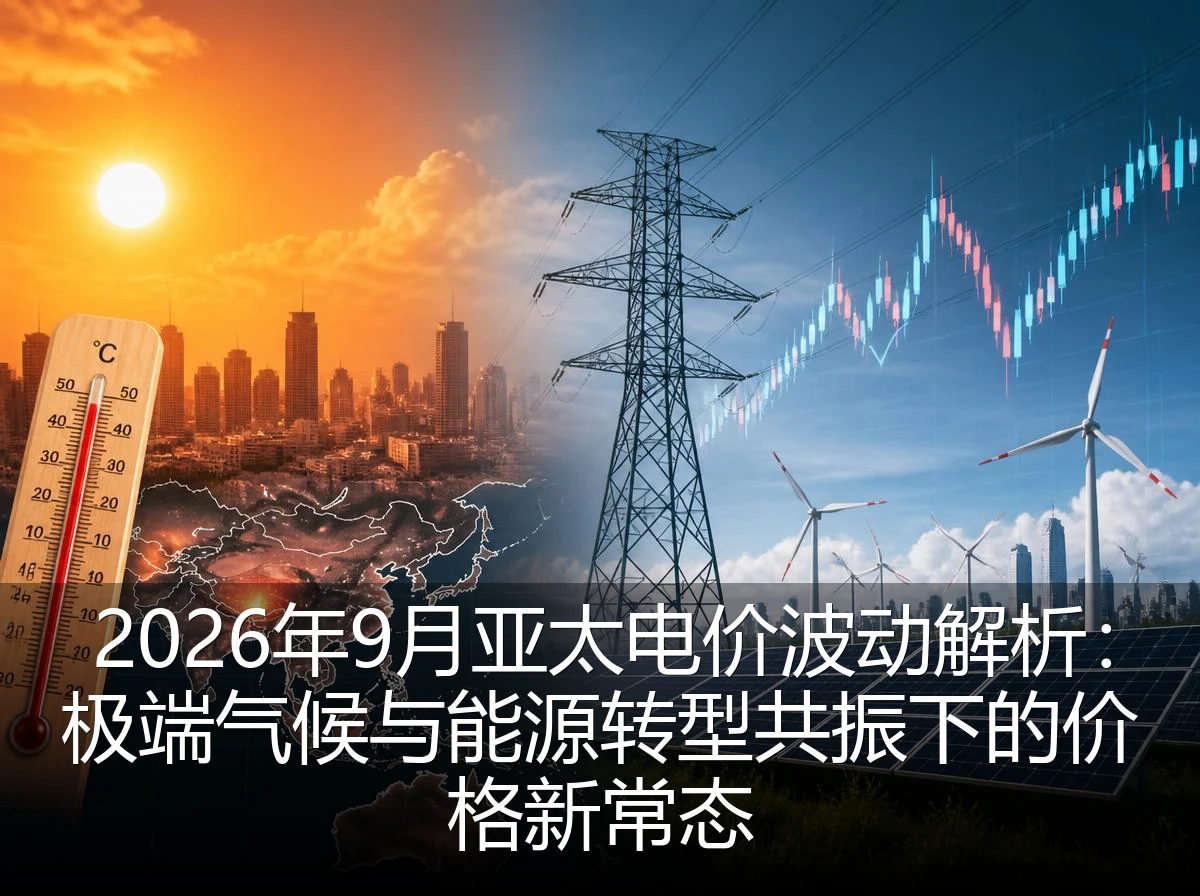



Energy Spot Prices | In-depth Analysis of Asia-Pacific Energy Market in September 2026: The New Normal of Prices Under the Resonance of Extreme Climate and Geopolitics
September 2026 sees the Asia-Pacific energy market experiencing an unprecedentedly complex situation. Extreme climate events and geopolitical factors are intertwined, jointly shaping the new normal of current energy prices. From international oil prices to regional electricity prices, from the natural gas market to coal prices, various energy products exhibit a trend of coexisting sharp fluctuations and structural changes. This article will delve into the price dynamics of the Asia-Pacific energy market during this special period, interpret the underlying drivers, and provide decision-making references for investors.
International Oil Prices: Dual Impact of Supply-Demand Imbalance and Geopolitical Games
Entering September 2026, international crude oil prices continue to fluctuate around $80 per barrel, showing distinct differentiation. WTI crude oil prices once broke through $85 per barrel in the first week of September, then fell back to around $82 per barrel; while Brent crude remained in the range of $84-86 per barrel. This price trend reflects the complex博弈 in the current global oil market.
From the supply side, the production policies of OPEC+ countries remain a key factor affecting oil prices. Although major oil-producing countries like Saudi Arabia and Russia maintain production cuts, the continuous growth of US shale oil production has alleviated market supply tensions to some extent. Meanwhile, the progress of Iran nuclear deal negotiations also affects market expectations, as any breakthrough could increase global crude oil supply.
In terms of demand, the Asia-Pacific region, as the world's largest oil consumer market, has its economic recovery directly impacting crude oil demand. The steady growth of China's economy, the expansion of India's manufacturing sector, and the acceleration of industrialization in Southeast Asian countries jointly support oil demand. However, the slowdown in European economies and rising global inflation may suppress some demand growth.
Geopolitical factors are particularly prominent in September. Tensions in the Middle East, the ongoing Ukraine conflict, and the escalation of Red Sea shipping security issues have brought uncertainty to oil supply. Especially, the disruption of Red Sea shipping has led to rising crude oil transportation costs, supporting oil prices.
Asia-Pacific Electricity Prices: Dual Drivers of Extreme Climate and Energy Transition
In September 2026, electricity prices in the Asia-Pacific region show significant fluctuations, with many countries' electricity prices breaking historical records or reaching new highs for the year. This price trend is mainly driven by the dual impact of extreme climate events and the energy transition process.
Extreme heat is the main factor pushing up electricity prices. From India to Southeast Asia, persistent high temperatures have led to a surge in air conditioning demand, with power loads hitting new highs repeatedly. Many states in India experienced the hottest summer on record in September, with air conditioning demand increasing by 15-20% year-on-year, directly pushing up electricity prices. Thailand, Vietnam, and other Southeast Asian countries face similar situations, with their power systems under great pressure.
Structural changes in the energy transition process are also reshaping the electricity price landscape. Although the increase in the proportion of renewable energy reduces long-term generation costs, its intermittent nature increases the adjustment difficulty of the power system. Under extreme weather conditions, the efficiency of wind and solar power generation decreases, forcing the power system to rely more on traditional fossil fuel power generation, which pushes up short-term electricity prices.
The progress in regional grid interconnection has alleviated electricity price pressure to some extent. Countries with abundant hydropower resources like Laos and Myanmar transmit electricity to Thailand, Vietnam, and other countries through cross-border transmission lines, optimizing regional power resource allocation. However, transmission capacity limits and cross-border coordination mechanisms still need further improvement.
Natural Gas Prices: Regional Differentiation and Supply Chain Restructuring
The natural gas market showed obvious regional differentiation in September. European TTF natural gas prices once surged by 12% at the beginning of September, reaching a new high for the year, while Asia-Pacific JKM LNG prices were under pressure and fell. This differentiation reflects the reconstruction process of the global natural gas supply chain.
The European natural gas market is affected by geopolitical factors and inventory levels. Uncertainty in Russian natural gas supply, pipeline maintenance in Norway, and supply fluctuations in North Africa have jointly pushed up European natural gas prices. At the same time, European natural gas inventories are at historic highs, providing a guarantee for winter supply and limiting the further upward space for prices.
The Asia-Pacific market is affected by the dual impact of increased LNG supply and slowing demand growth. The enhanced LNG export capacity of countries like Australia and the US has increased market supply. Meanwhile, the growth of natural gas demand in major importing countries like China and Japan has slowed down, especially as China reduces its dependence on natural gas by increasing coal use and renewable energy generation.
The regional LNG trade pattern is changing. Traditional importing countries like Japan and South Korea have seen slowing LNG demand growth, while emerging markets like India and Pakistan have increasing import demand. This structural change is reshaping the pricing mechanism of the Asia-Pacific natural gas market.
Coal Prices: Supply-Demand Mismatch and Policy Regulation
The coal market also presented a complex situation in September. After a sharp rise in international thermal coal prices in August, they fell in September but remained at relatively high levels. This price trend reflects the mismatch of global coal supply and demand.
In terms of supply, the coal production of major exporting countries like Indonesia and Australia has been affected by weather factors and labor issues. Meanwhile, China, as the world's largest coal producer and consumer, its domestic coal market policies also affect international coal prices. China is striving to stabilize coal prices by increasing domestic coal production and imports.
In terms of demand, coal demand in Asia, especially in India and Vietnam, remains strong. As the world's second-largest coal consumer, India's power sector still has a high dependence on coal. Southeast Asian countries like Vietnam increase coal power generation to meet rapidly growing electricity demand.
Policy factors play an important role in the coal market. Governments influence coal use through carbon pricing, environmental regulations, and other means. At the same time, the development of renewable energy is gradually replacing coal power generation, especially as the flexibility of the power system enhances.
New Normal in the Energy Market: Coexistence of Challenges and Opportunities
The Asia-Pacific energy market in September 2026 showed several prominent features, indicating the formation of a new normal for energy prices.
First, the impact of extreme climate events on energy prices is becoming increasingly significant. Whether it is the surge in electricity demand caused by high temperatures or the impact of extreme weather on renewable energy generation, energy prices have become more sensitive and volatile. This trend is expected to continue and even intensify in the coming years.
Second, the impact of geopolitical factors on the energy market is more direct and far-reaching. From Red Sea shipping to Middle East situations, geopolitical risks have become important drivers of energy prices. This impact is not limited to the oil market but also extends to other energy products like natural gas and coal.
Third, structural changes in the energy transition process are reshaping the energy price landscape. The increase in the proportion of renewable energy, the improvement of energy efficiency, and the digitalization of the energy system are all changing the supply-demand relationship and price formation mechanism of the traditional energy market.
For investors, this new normal brings both challenges and opportunities. In a market environment with increased volatility, investors who can accurately grasp market trends and effectively manage risks will obtain excess returns. Meanwhile, the energy transition also provides broad development space for new energy investment, energy technology innovation, and energy services.
Investment Strategy Recommendations
Facing the current complex energy market environment, investors need to adopt more flexible and diversified investment strategies.
First, focus on energy infrastructure investment. Infrastructure projects such as grid upgrades, energy storage facilities, and cross-border transmission lines have long-term investment value in the energy transition process. Especially in the context of frequent extreme climate events, resilient energy infrastructure will have more advantages.
Second, seize the investment opportunities in renewable energy. Renewable energy projects such as solar, wind, and hydropower have stable investment returns under the dual promotion of policy support and cost reduction. At the same time, emerging technology fields like green hydrogen and energy storage are also worth attention.
Third, emphasize energy efficiency improvement. In the context of high energy prices, energy-saving and consumption-reducing technologies and services have broad market demand. Enterprises can not only reduce costs but also enhance competitiveness by improving energy efficiency.
Finally, strengthen risk management. In a market environment with increased volatility, effective risk management strategies are crucial. This includes diversifying investment portfolios, using financial derivatives to hedge risks, and establishing flexible decision-making mechanisms.
In conclusion, the Asia-Pacific energy market in September 2026 has shown the雏形 of a new normal for energy prices. The intertwined impact of extreme climate and geopolitical factors, and the structural changes in the energy transition process, jointly shape the current market landscape. For investors, understanding the drivers behind these changes and adopting appropriate investment strategies will enable them to seize opportunities and achieve long-term value growth in this complex environment.